Ductless Systems
Ductless mini split maintenance, yours and the technician's
Ductless mini split maintenance is two jobs that get sold as one. The first is washing a pair of mesh filters, which takes ten minutes and is yours. The second is cleaning the coil, the blower wheel and the drain, which is a technician's. How often each is due is less settled than it sounds: we put five published schedules side by side, and on the simplest question, how often to clean the filter, they differ by about four times.
(844) 206-9145Toll-free and answered every day of the year. The call reaches an independent licensed and insured heating and cooling company covering your area. We do not service equipment ourselves, which is why this page starts with the part you can do without calling anyone.
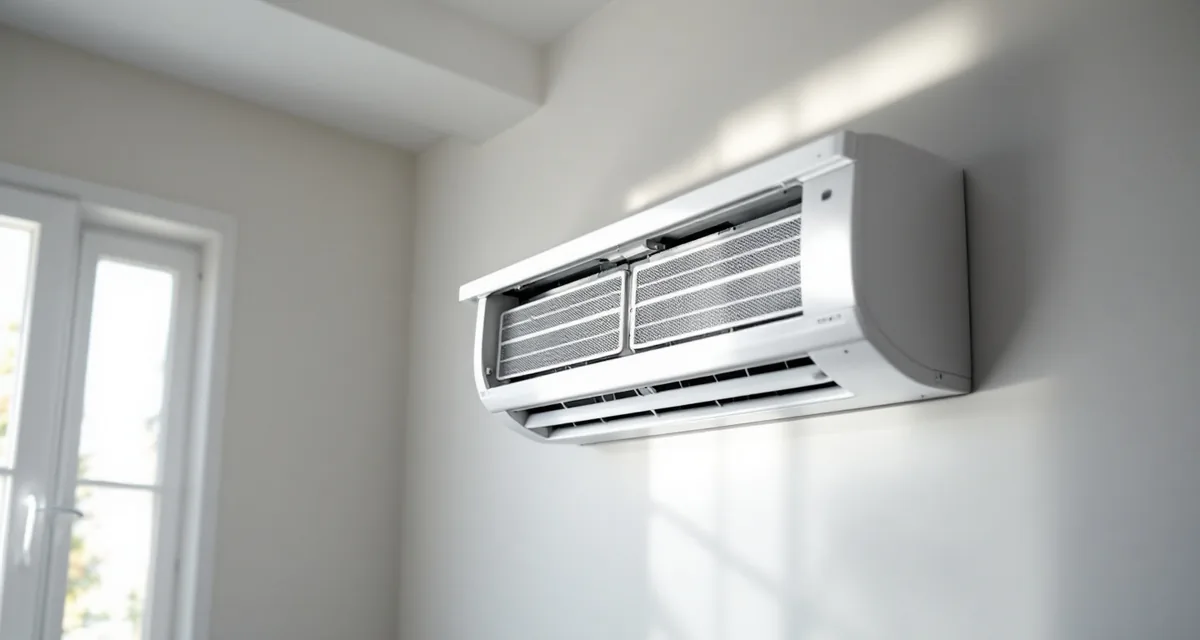
Ductless mini split maintenance comes in two halves
- Yours: filters, the outside of the unit, and the space around the outdoor one. Minutes, no tools, every few weeks in season.
- The technician's: the coil, the blower wheel, the drain pan and the refrigerant circuit. Once or twice a year.
- The symptom that says you are late: weak airflow, a musty smell, or water. Each points at a different part.
Why a mini split needs more attention than its size suggests
A central system has one large filter that sits in a return duct, and one indoor coil that almost nobody sees. A mini split puts a small filter and a small coil in every room it serves, right at the point where the room's air is drawn in. Mini split ac maintenance is therefore more frequent and more spread about: each indoor unit is its own little air handler with its own filter, its own coil and its own drain.
Do mini split systems require more maintenance than central air? In visits from a technician, about the same. In attention from the owner, yes, because the filters are small and are meant to be washed, not thrown away every few months. Mini split air conditioner maintenance done on time is the cheapest thing on this page. Maintenance on mini split equipment that has been skipped for two summers is the visit where a technician spends an hour on a single blower wheel.
This page covers ductless mini-split maintenance in the order it comes due. Whichever spelling you arrived with, mini-split maintenance or ductless/mini split maintenance, it is the same list, and most of it does not need a van.
Our Own Reading
Our reading: five published maintenance schedules, side by side
Everyone publishing on this subject gives an interval with confidence. We read five of them on the same day and wrote the numbers down next to each other.
What was compared
Four equipment manufacturers and one national service franchise publish maintenance guidance for ductless systems that states intervals in plain numbers. We read each on October 9, 2026 and recorded three things: how often it says to clean the filter, how often it says to have a professional visit, and how much clear space it asks for around the outdoor unit. The names link to the pages we read.
The table
| Publisher | Clean the filter | Professional visit | Clear space outdoors |
|---|---|---|---|
| Carrier manufacturer | Every 4 to 6 weeks | At least once a year | Not stated |
| Bryant manufacturer | Every 2 to 4 weeks | Twice a year | Not stated |
| Trane manufacturer | Every 2 weeks in peak season, monthly in light use | At least annually, twice a year if it also heats | Not stated |
| MRCOOL manufacturer | Check every 30 to 60 days | Once a year | At least 2 feet on all sides |
| Aire Serv service franchise | Monthly | Every 6 months | 18 inches |
The part that changes what you do
On filters the five run from every two weeks to every 60 days, a spread of about four times. On professional visits two say once a year (Carrier and MRCOOL), two say twice (Bryant and Aire Serv), and Trane says at least once, and twice if the system heats as well as cools. Only two of the five give a figure for clear space around the outdoor unit, and they differ too: 18 inches in one, 2 feet in the other.
The disagreement is not carelessness. Each number is right for some house. A unit running day and night in a home with two dogs needs its filter washed every fortnight. The same unit in a guest room used on weekends does not. What the spread tells you is that there is no single interval to follow, and that the useful instruction is the one Trane gives: more often in peak season, less often in light use.
Where the five agree is more useful than where they differ. Every schedule that mentions the indoor coil puts cleaning it with a professional. Every one treats the filter as the owner's job. That division, and not the number of weeks, is the part to take away.
What this reading cannot tell you
- These are public web pages, not your owner's manual. The manual for your model is the authority for your unit and may give a different interval.
- Five is five. We chose publishers who state numbers plainly. Others publish guidance without figures and are not in the table.
- One of the five is written for air conditioners generally. Its filter interval is not specific to ductless units, and it is the most relaxed of the five.
- A service company has an interest in visits. So does a manufacturer in a long-lived product. Read each interval with its author in mind.
The Schedule
A mini split maintenance checklist by month, season and year
One list, sorted by how often each task comes round and by who does it.
| When | Task | Who |
|---|---|---|
| Every 2 to 4 weeks in season | Wash the mesh filters and let them dry | You |
| Monthly | Clear leaves, grass and debris from around the outdoor unit | You |
| Monthly in cooling season | Check that the drain is dripping outdoors and nothing is dripping indoors | You |
| Every few months | Wipe the casing and louvres of the indoor unit; look at the coil with a torch | You |
| Before each season | Run the unit in the coming mode for an hour and listen | You |
| Once or twice a year | Clean the indoor coil, blower wheel and drain pan; clean the outdoor coil | Technician |
| Once or twice a year | Check electrical connections, controls and refrigerant pressures | Technician |
How often to clean mini split filters, in one sentence
Every two to four weeks while the unit runs daily, monthly when it runs less, and at once if the airflow has dropped. That sentence reconciles all five schedules above.
What the professional half is checked against
ENERGY STAR publishes a maintenance checklist for heating and cooling equipment and recommends an annual pre-season check-up by a contractor. Its list of what a check-up should include is a fair yardstick for a mini split visit: tighten electrical connections, check and inspect the condensate drain, check the system's controls, clean the evaporator and condenser coils, check the refrigerant level, and clean and adjust the blower. If a visit does not cover those, ask what it did cover.
Ten Minutes
How to clean mini split filters
The whole of the owner's half, more or less, and the task that prevents most of the others.
The steps
Switch the unit off
At the remote, and wait for the louvre to close and the fan to stop.
Lift the front panel
It hinges upward from the bottom edge and clicks open. The filters are the mesh panels behind it.
Slide the filters out
Each lifts slightly and pulls down and toward you. Note which way round they sit.
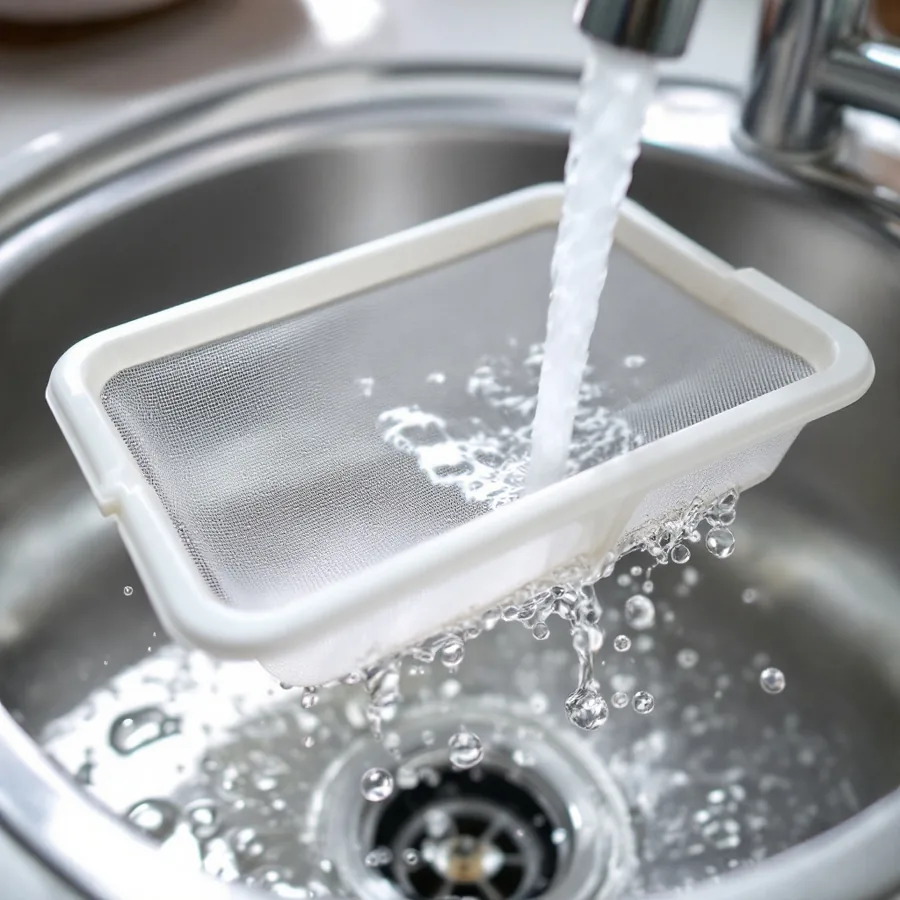
Vacuum, then rinse
A brush attachment on low suction, then lukewarm water from the clean side through to the dirty side.
Dry completely, refit, close
In shade, not in sun or over a heater. A damp filter put back is a start on the next problem.
What the manufacturers add
Trane's guidance on how to clean a mini split filter is specific on two points worth repeating: use low suction, because suction that is too strong can damage the mesh, and let the filters dry thoroughly before they go back. It also notes that the smaller deodorizing filter some units carry should not be allowed to get wet. That second filter is replaced, not washed, and your manual says how often.
Mistakes that turn a ten-minute job into a visit
- Running the unit with the filters out to dry them. The coil behind them catches everything the filter would have.
- Hot water or a stiff brush. Mini split filter cleaning needs neither, and both distort the mesh.
- Refitting them damp. Moisture and dust on a surface air is pulled across is how a smell begins.
- Skipping one unit. With several indoor units, cleaning mini split filters means all of them, on the same day, so none is forgotten.
That is all there is to how to clean mini split filter panels. If you clean mini split filter panels on time and do nothing else on this page yourself, you have done most of what an owner can do.


The Rest Of The Indoor Unit
How to clean a mini split indoor unit: the part you can reach
Beyond the filters there is a little more that is safely yours, and a clear point at which to stop.
What cleaning a mini split means for an owner
How to clean a mini split depends on who is asking. For an owner, cleaning a mini split means the filters, the casing, the louvres and a look at the coil. Carrier's guidance for the indoor unit is to wipe down the cabinet with a dry cloth or a small vacuum to prevent dust building up. That, with the filters, is how to clean mini split equipment without opening anything that was not designed to be opened by hand.
How do you clean a mini split without making it worse
- Power off first. At the remote, and at the breaker or outdoor disconnect if you are going further than the filters.
- Dry or barely damp cloth on the casing. No sprays into the outlet. There is a circuit board at one end of every indoor unit.
- Move the louvre by hand only if the manual says you may. On many units the motor is geared and forcing it strips the gear.
- Look, do not scrub. With the filters out and a torch, the coil should be bright metal. Grey felt on it means the deep clean is due.
Where the owner's part ends
How to clean mini split indoor unit components beyond that point is a different question from how to clean a mini split inside unit casing. Past the filters lie the coil fins, which bend at a touch, the blower wheel, which is behind the coil and cannot be reached without dismantling, and the drain pan under both. Cleaning a mini split system that far is the professional half. People who search for how to clean a mini split air conditioner, how to clean a mini split ac, cleaning a mini split air conditioner, cleaning ductless mini split units, or mini split air conditioner cleaning are mostly asking about that half, and the next section is about it.
So when a guide tells you to clean mini split equipment thoroughly every month, read it as the filters and the casing. Mini split cleaning in the deeper sense is a once or twice a year job with the unit partly taken apart.
The Deep Clean
Coils and the blower wheel: the deep clean and the mini split cleaning kit
This is the work every published schedule assigns to a professional, and the work a growing shelf of products invites you to do yourself.
What gets dirty and why it matters
Air passes the filter, then the coil, then the blower wheel that throws it into the room. Fine dust that the filter misses sticks to the coil, which is wet whenever the unit is cooling. The blower wheel, a long drum of small curved blades, collects the same damp dust, and once its blades are coated it moves less air and begins to smell. Mini split evaporator coil cleaning and mini split blower wheel cleaning are the two tasks that restore airflow.
How a technician does it
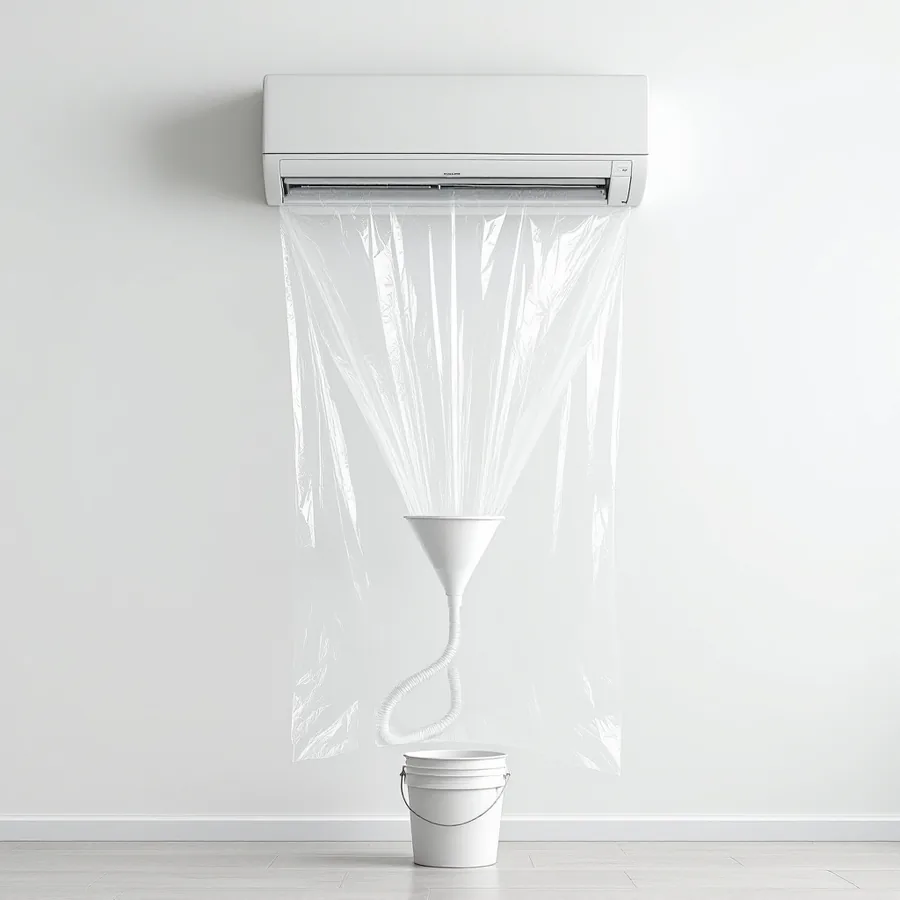
A waterproof bag, usually called a bib, is hung beneath the indoor unit to catch the rinse and run it to a bucket. The casing comes off. The coil is treated with a cleaner made for the purpose and rinsed at low pressure, the blower wheel is washed in place or removed, and the drain pan and line are flushed. Carrier describes the professional part as using specialised solutions to clean the evaporator and condensing coils and remove hidden build-up. Bryant puts it as a deep clean of the blower wheel and coils together with a thorough electrical inspection.
The kits
A mini split cleaning kit sold to homeowners is a version of the same thing: a mini split cleaning bib, a pump sprayer or hose, and a bottle of coil cleaner. A mini split bib cleaning kit, a mini split coil cleaning kit and a mini split ac cleaning kit differ mostly in the size of the bag and what is in the bottle. People ask for the best mini split cleaning kit, and the honest answer is that the bag matters least. The risk is in the water.
| Part | What a careful owner can do | Where it goes wrong |
|---|---|---|
| Coil face | Low-pressure rinse with a purpose-made cleaner, bag fitted | Bent fins; water driven toward the electronics at one end |
| Blower wheel | Rinse in place through the outlet | Half-cleaned wheel throws dirty water into the room on start-up |
| Drain pan | Flush with the same rinse | Loosened debris blocks the drain line it was meant to clear |
| Control board | Cover it, keep water away | The expensive part, and the one a splash ends |
How to clean mini split coils without regretting it
If you do it yourself: power off at the breaker, cover the end of the unit where the wiring enters, use a cleaner labelled for indoor coils, rinse gently from the top down, and let the unit dry before restoring power. A mini split cleaning system marketed as no-rinse still leaves residue to drain away, so the bag is not optional. If any of that makes you hesitate, the hesitation is good judgement, and it is the reason the manufacturers put this job on the professional list.


The Water
How to clean the mini split drain line
A small tube that causes most of the damage a neglected mini split does to a house.
What it does
A cooling coil takes water out of the air. That water drips into a shallow pan under the coil and leaves through a narrow line, by gravity or by a small pump, to somewhere outdoors. The line is narrow, it is always damp, and dust washed off the coil ends up in it. Left alone it grows a jelly that eventually closes it.
How to clean mini split drain line blockages that have started
- Find the outlet outdoors. In cooling weather it should drip steadily. No drip from a unit that has been running for hours is the early warning.
- Clear the outlet end. Insects and dirt block the last inch more often than the middle.
- Draw the blockage out, do not push it in. A wet vacuum on the outdoor end pulls the plug toward the outlet.
- Flush. Carrier's guidance is that it is generally safer to use distilled white vinegar than bleach to clear a drain line, and that a professional is best equipped to clear a clog.
When it has a pump
Where the drain cannot fall, a small condensate pump lifts the water. Mini split drain line cleaning then includes the pump's reservoir, which collects the same sludge. A pump that hums and moves no water, or a unit that stops itself with a fault light on a humid day, is usually this.
How often
Bryant's schedule says to inspect the drain line monthly to prevent water damage. In a dry climate that is cautious. In a humid one it is about right, and it takes as long as walking outside and looking for a drip.
Outside
How to clean a mini split outdoor unit
The half of the system that sits in the weather and asks for the least.
What it needs
Air has to pass freely through the coil on the back and sides of the outdoor unit. Cleaning mini split outdoor unit coils, or cleaning outdoor mini split equipment generally, is therefore mostly about what is around them. Carrier's list for the owner is short: clear away leaves, grass clippings and debris from the base, keep shrubs trimmed back, and rinse the cabinet gently with a garden hose with the power off, avoiding high-pressure nozzles.
How much space
Of the five schedules we compared, two of the five put a number on it: 18 inches in one and 2 feet on all sides in the other. Your installation manual gives the figure for your model, and it is usually larger at the front, where the fan discharges, than at the back.
How to clean mini split outdoor unit coils safely
- Power off at the disconnect. The switch box on the wall beside the unit.
- Hose, not pressure washer. The fins are thin aluminium and fold flat under a jet, which blocks the airflow you were trying to restore.
- Rinse from the inside out if you can reach. Otherwise straight on, never at an angle across the fins.
- Leave the casing on. What is behind it is the technician's.
In winter
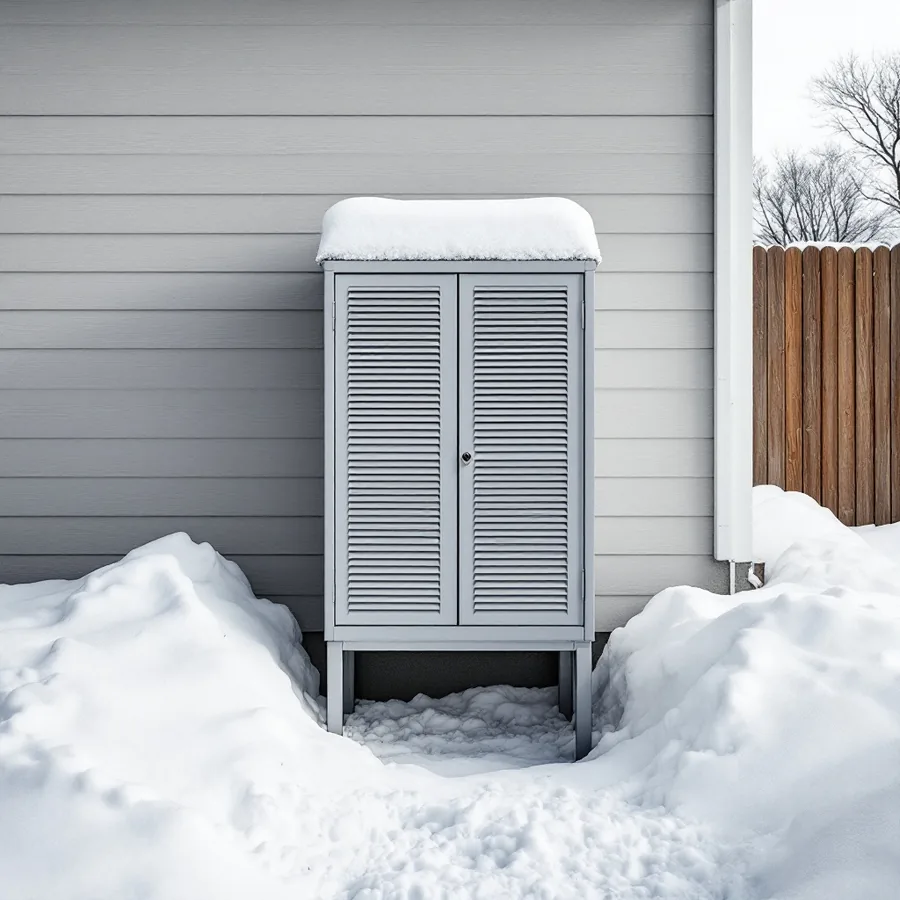
A unit that heats needs its coil clear of snow and its base clear of ice, because it defrosts itself and the meltwater has to drain away. Do not chip ice off the coil. Clear the snow around it and let the defrost cycle do the rest.

The Smell
Mold in a mini split, and the smell that announces it
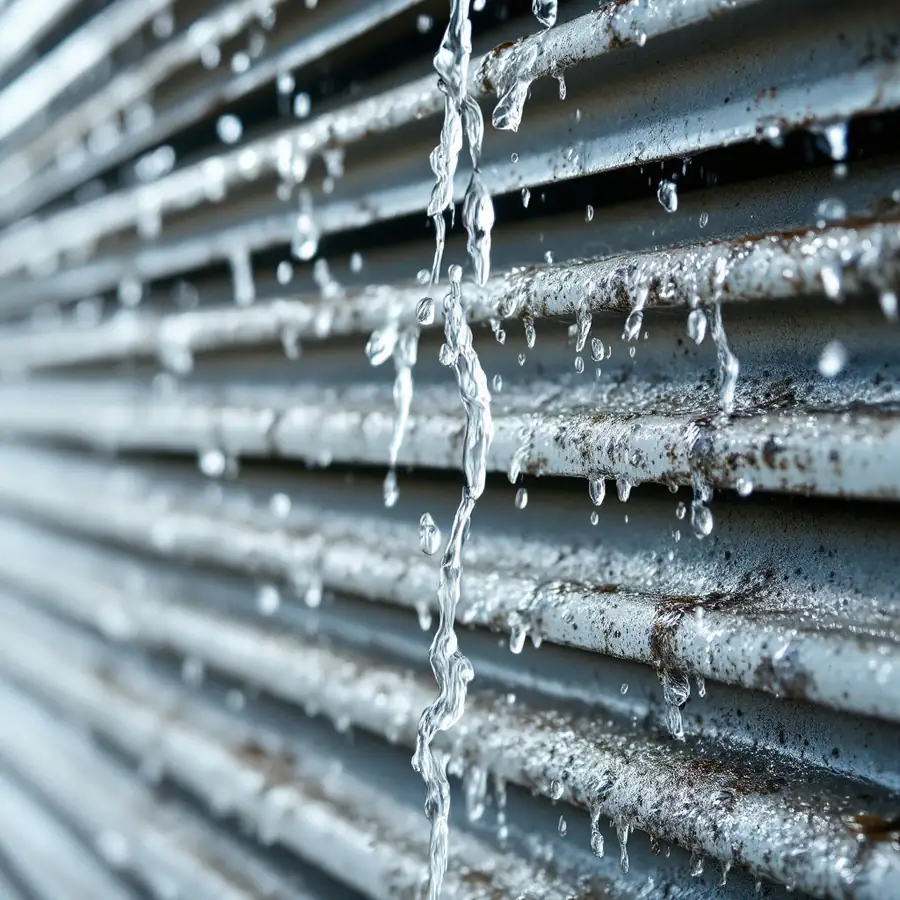
A musty smell on start-up is the commonest complaint about these units, and it has one cause.
Why it grows there
The Environmental Protection Agency's guidance on mold is that it can grow on nearly any organic material as long as moisture and oxygen are present. The inside of a cooling unit supplies both, and the dust on the coil and blower wheel supplies the organic material. Mold in mini split units is not a defect in the unit. It is dust plus water plus time.
What stops it
- Clean filters. Less dust reaches the wet surfaces.
- A drain that empties. The same agency lists poorly draining condensate pans among the hidden sources of moisture, and says wet materials should be dried within 24 to 48 hours.
- Letting the unit dry itself. Many units have a setting that runs the fan for a while after cooling stops. If yours does, use it.
- Reasonable indoor humidity. The agency's figure is below 60 percent relative humidity, ideally between 30 and 50 percent.
Once it is there
Mini split mold on the blower wheel does not come off with a spray through the outlet. It needs the deep clean described above, with the wheel washed properly. Carrier's list of professional tasks includes applying a treatment to discourage future growth on the coils. If someone in the house is sensitive to it, do not attempt this one yourself, and see our page on indoor air quality for the wider picture.
Water Indoors
Mini split leaking water: where it is coming from
A mini split leaking water indoors is nearly always condensate that could not leave the way it should.
Why is my mini split leaking water
| Where you see it | Usual cause | Whose job |
|---|---|---|
| Dripping from the front or the outlet | Pan overflowing because the drain is blocked, or the coil icing and thawing behind a clogged filter | Filter: you. Drain: you or a technician |
| Running down the wall behind the unit | Unit not level, or the drain hose kinked or disconnected inside the wall | Technician |
| From inside the unit at one end | Cracked or displaced drain pan, or a failed pump | Technician |
| Only on very humid days | A drain that copes with ordinary load and not with peak | Clean it; if it recurs, a technician |
Reading the pattern
Why is my mini split leaking water from the front is the commonest form of the question, and the filter is the first thing to check, because a starved coil freezes and then drips when the unit rests. Mini split leaking water inside in a steady trickle, with clean filters, points at the drain. If you are asking why is my mini split leaking water inside only after a long run, that is a partial blockage. Mini split leaking water down wall surfaces behind the unit is the one not to wait on, since the wall is absorbing it.
What to do first
Switch the unit off, so it stops making water. Put a towel and a container under it. Check the filters, then go outside and look at the drain outlet. A mini split leaking water inside house walls for days is how a small job becomes a repair to the wall as well. Mini split leaking water from inside unit casings, with no blockage you can find, is a call. The same goes for a mini split ac leaking water in its first season, which is an installation fault and belongs to whoever installed it.



Weak Or Warm
Mini split not cooling: the causes maintenance prevents
Most cases of a mini split not cooling are airflow, and airflow is maintenance.
Why is my mini split not cooling
- The filter. The first check for a mini split ac not cooling, and the commonest answer.
- The coil and blower wheel. A mini split not cooling enough, with clean filters and a fan that sounds busy, is usually a coated wheel moving little air.
- The outdoor unit. Blocked by leaves, a fence, or a cover someone forgot to remove.
- The mode. Set to dry or fan, or to heat by a mis-pressed button. Check before anything else.
- Refrigerant. If you are asking why is my mini split running but not cooling, with everything above ruled out, the charge may be low, which means a leak, which means a technician.
When it is new
A brand new mini split not cooling is not a maintenance matter. A new system that underperforms was sized, charged or connected wrongly, and that is for the installer to put right under the installation warranty. Do not let anyone treat it as wear.
Where this page stops
If my mini split is not cooling is where you started and none of the above fits, our page on an air conditioner that is not cooling works through the faults one by one, including the ones a ductless system shares with a central one.
The Other Half
What a professional mini split service visit includes
Mini split service is a short list, and knowing it lets you tell a real visit from a filter rinse with an invoice.
The list
- Indoor coil cleaned with the casing off and a bag fitted.
- Blower wheel cleaned, in place or removed, and checked for balance.
- Drain pan and line flushed, pump tested if there is one.
- Outdoor coil cleaned and the fan and mounting checked.
- Electrical connections tightened and controls tested in each mode.
- Refrigerant pressures and temperatures checked for signs of a leak.
- A written note of what was found.
Names it is sold under
The same visit is advertised as mini split heat pump service, ductless mini split heat pump service, mini split air conditioning service or mini split hvac service. A ductless mini split cleaning service is usually the first three items on the list without the last three. Mini split maintenance services sold as an annual plan are the full list on a schedule. A mini split repair service, mini split repair services in general, and firms offering ductless mini split ac repair services are a different thing: they come when something has failed.
What a new system needs
New mini split service in the first year is mostly the filters. A first professional visit after the first full season is still worth having, because it is the cheapest moment to find a drain that was run badly or a connection that has loosened. If you used a mini split installation service that offers a first-year check, take it.
Who should do it
How to service a mini split properly involves the refrigerant circuit, and that part is regulated. The mini split service person at your door should be a licensed heating and cooling technician who holds the federal refrigerant certification, and it is reasonable to ask.
The Bill
Mini split maintenance cost, cleaning cost and service cost
We publish no price averages. What we can set out is what the figure is made of.
What moves it
- The number of indoor units. Mini split maintenance cost is driven by heads, because most of the labor is indoors. Ask whether a price is per system or per indoor unit.
- How long since the last one. Mini split cleaning cost on a unit serviced yearly is a routine visit. On one neglected for years it is a strip-down.
- Access. A unit over a stairwell or a cassette in a ceiling takes longer than one above a sofa.
- What is included. Mini split service cost quoted without the blower wheel is not the same visit as one with it.
Plans against single visits
A maintenance plan spreads one or two visits across the year and usually adds priority when something fails. Whether it is worth it depends on the number of units and on whether the system heats as well as cools. For a single unit used in summer, one visit a year bought when you want it is often enough.
The arithmetic that matters
Set the cost of a visit against what it prevents: a blocked drain and a stained wall, a coil so coated the unit runs twice as long for the same cooling, a blower motor worked to failure. None of those is certain. All of them are what the schedule exists to avoid. Our page on mini split installation cost covers the larger figure this one protects.
Both Seasons
Mini split heat pump maintenance: heating doubles the season
A unit that heats as well as cools works all year, and its schedule should say so.
What changes
Ductless mini split heat pump maintenance covers everything above, twice. The filters load in winter as they do in summer. The outdoor unit, which rests through winter on a cooling-only system, now runs through the worst weather of the year, frosting and defrosting. That is why Trane's guidance is that twice a year is better for a system that both heats and cools.
The winter list
- Keep snow off and away from the outdoor unit. Above the snow line is where it should have been mounted.
- Keep the base draining. Defrost water that cannot run off freezes into the bottom of the coil.
- Expect steam and a pause. A defrost cycle is normal. A unit encased in ice is not.
- Filters, as in summer. A starved coil heats poorly for the same reason it cools poorly.
Mini split heat pump maintenance is where the second annual visit earns its place: one before cooling, one before heating. Our page on heat pumps explains what the outdoor unit is doing in each season, and our general page on heating and cooling maintenance covers systems with ducts.
The Line
The service port and what the refrigerant rules reserve
One part of this system is not the owner's to open, and the reason is federal.
What the port is
On the outdoor unit there is a capped valve through which a technician connects gauges to read the system's pressures. A mini split service port adapter is the small fitting that joins standard gauge hoses to it, since many ductless units use a smaller thread. The adapter is sold freely. Using it is another matter.
What the rule says
The Environmental Protection Agency's Section 608 requirements say that technicians who maintain, service, repair or dispose of this kind of equipment must be certified, and they define the work to include attaching and detaching hoses and gauges to measure pressure, and adding or removing refrigerant. Checking the charge is on that list. So is topping it up.
What that means for maintenance
Everything on the owner's half of this page stays outside the refrigerant circuit, by design. A system does not use up refrigerant. If it is low, it has leaked, and the remedy is to find the leak, not to add more. That is diagnosis, and it belongs to the certified half.
Work It Out
Work out your own schedule
Three questions, nothing sent anywhere. What comes out is a filter interval for your pattern of use, how many professional visits it points to, what to watch for in your kind of household, and the question to ask about price.
We are paid the same fixed fee for an introduction whether you book one visit a year or two, which is why the first answer here is the one that needs no visit at all.
The Short List
Questions to ask a mini split service company
Each has a short answer if the company does this work properly.
- Does the visit include the blower wheel? The part most often left out and most often the cause.
- Is the price per system or per indoor unit? With several units it changes everything.
- Do you fit a bag and take the casing off? Or spray through the outlet.
- Will you flush the drain and test the pump? The cheapest insurance on the list.
- Do you service this brand, and do you carry its parts? Ductless boards and sensors are brand-specific.
- Is your technician certified to handle refrigerant? For anything beyond cleaning.
- Will I get a written note of what you found? It is the record a warranty claim asks for.
What we do, and what we do not
We are a referral service, not a heating and cooling company. We connect homeowners with independent licensed and insured companies and are paid a fixed fee for the introduction. We do not service equipment, set anyone's prices, or sell cleaning products.
Straight Answers
Questions people ask about mini split maintenance
How often should mini split filters be cleaned?
Every two to four weeks while the unit runs daily, and about monthly when it runs less. We compared five published schedules and they range from every two weeks to every 60 days, because each is right for a different house. Pets, smoke, cooking and building dust all shorten the interval. If the airflow from the unit has weakened, the filter is due regardless of the date.
How often does a mini split need professional maintenance?
Once or twice a year. Of the five schedules we read, two say once and two say twice, and Trane says at least once and twice if the system both heats and cools. ENERGY STAR recommends an annual pre-season check-up for heating and cooling equipment. A unit that only cools in summer can reasonably have one visit; a heat pump that runs all year has a case for two.
Can I clean a mini split myself?
The filters, the casing and the area around the outdoor unit, yes, and those are most of what keeps the unit working. The coil, the blower wheel and the drain pan need the casing off and water used close to the electronics, and every published schedule that mentions the indoor coil assigns it to a professional. Kits exist for doing it yourself. The risk is water reaching the control board.
Why is my mini split leaking water inside?
Usually because condensate cannot drain. A blocked drain line makes the pan overflow, and a clogged filter can make the coil ice over and then drip when the unit rests. Switch the unit off, check the filters, and look for a drip at the drain outlet outdoors. Water running down the wall behind the unit suggests it is out of level or the drain hose has come adrift, which needs a technician.
Why does my mini split smell musty?
Because dust and moisture have met on the coil or the blower wheel. The Environmental Protection Agency notes that mold can grow on nearly any organic material where moisture and oxygen are present, and a cooling unit provides both. Clean filters and a free-flowing drain prevent it. Once it is established on the blower wheel it needs a proper deep clean, not a spray through the outlet.
Do mini splits need more maintenance than central air?
More attention from the owner, and about the same from a technician. A central system has one large filter and one hidden coil. A mini split has a small washable filter and a small coil in every room it serves, so the routine is more frequent and spread across the house. In return there are no ducts to clean, seal or lose conditioned air through.
What does a mini split service visit include?
Cleaning the indoor coil and blower wheel with the casing off, flushing the drain pan and line, cleaning the outdoor coil, tightening electrical connections, testing the controls in each mode and checking refrigerant pressures. ENERGY STAR's maintenance checklist lists the same items for heating and cooling equipment generally. Ask in advance whether the blower wheel is included, because it is the part most often left out.
Is a mini split cleaning kit worth buying?
For an owner who is careful with water and electricity, it can do the coil face and the drain pan between professional visits. It does not replace them, because it cannot clean the blower wheel thoroughly or check anything electrical. The bag in the kit matters less than the method: power off at the breaker, electronics covered, low pressure, and the unit left to dry before it is switched back on.
Can I check or top up the refrigerant myself?
No. Environmental Protection Agency rules require certification for attaching gauges to this kind of equipment and for adding or removing refrigerant. A system does not consume refrigerant in normal use, so a low charge means a leak, and the remedy is to find and repair it. Adapters that fit the service port are sold freely, and using them is the regulated part.
Where This Comes From
Sources and method
- Our own comparison of five published maintenance schedules: the pages linked by name in the table above, each read on 9 October 2026. What we recorded from each, and the limits of the comparison, are in the file published beside this page.
- What a professional check-up should include, and how often: ENERGY STAR, Maintenance Checklist.
- Why mold grows and the humidity and drying figures: Environmental Protection Agency, Mold Course, Chapter 2.
- Who may connect gauges and handle refrigerant: Environmental Protection Agency, Section 608 Technician Certification Requirements.
- Where ductless systems are used and how they are sized: ENERGY STAR, Ductless Heating and Cooling.
- How many homes have these systems and how many indoor units each: our tabulation of the Energy Information Administration's 2020 household survey, set out on our installation cost page.
Our editorial standards explain how we source and check what we publish. Every source above was read on the day of publication. Where the published schedules disagree we print the range and say why. Your owner's manual is the authority for your model, and nothing here replaces it. We publish no price averages and no product rankings. We are a referral service rather than a heating and cooling company. Last updated .
Before you call anyone
The flat-fee match — we are paid for the introduction, not for the size of your job
Most heating and cooling advice is written by the company that wants to do the work. That is not a failing of the people who read it; it is a defect in who is talking: the diagnosis, the estimate and the invoice come from one party, and no amount of care on your side fixes that.
We are built the other way round. We do not repair, install or sell equipment, so the payment reaches us when you are connected to a licensed, insured heating and cooling company — the same amount whether you need a forty-dollar capacitor or a whole new system. Nobody here has a reason to talk you into the larger number. You can check that rather than take it on trust: how we make money is written down, and this site keeps telling readers when not to buy — that a heat pump may not pay off on cheap gas, that most people should buy a hygrometer before a humidifier, that the federal order puts air cleaners last. Why does not everyone work this way? Because a flat fee leaves money on the table every time the job turns out to be big.
Waiting is the one thing that actually costs money. A system that fails in the first heatwave or the first hard freeze puts you in the overtime queue — the federal occupational handbook says this trade works overtime in peak season, and you pay for it. A refrigerant leak on a running system takes the compressor with it; a blocked condensate drain becomes a ceiling. And if it turns out to be a filter, say so on the call. We will tell you, and that call earns us nothing.
Not for you if: you want a price over the phone — nobody honest gives one without seeing the house; you need a guarantee of same-day arrival — we cannot promise that for a company we do not run; the building is commercial; or you would rather do it yourself, in which case the pages on this site are written so that you can.